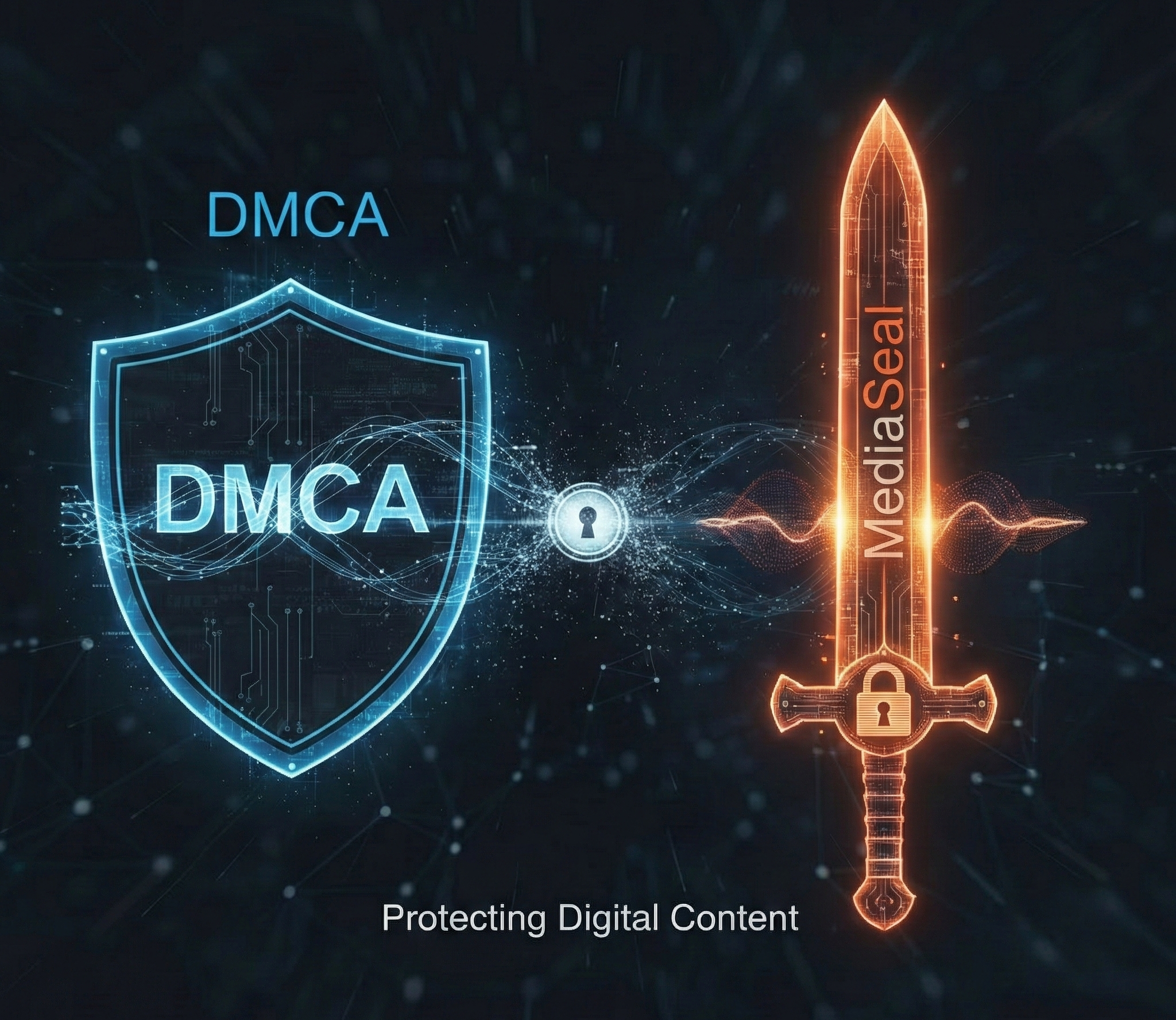
DMCA is the shield, but where is your sword?
The “Takedown” Myth
Every creator knows about the DMCA (Digital Millennium Copyright Act). It’s the law that allows you to demand that platforms like YouTube, Instagram, or a web host remove stolen content. Ideally, you send a notice, and the stolen content disappears. But in reality, it’s a messy battle.
The Counter Notice A thief can file a counter-notice simply claiming, “I own this.”
The Burden of Proof: Once they dispute your claim, the platform steps back. It becomes your word against theirs. Unless you sue (which costs thousands), the content often stays up.
- The Game of Whack-a-Mole: You take a video down on Monday; they re-upload it on Tuesday. The DMCA is a powerful legal weapon, but it has no ammunition. MediaSeal provides the ammo.
How MediaSeal “Turbocharges” Your DMCA Claims
MediaSeal doesn’t replace the DMCA; it makes it enforceable. We leverage the global C2PA Standard (the same technology used by major news agencies) to secure your work—whether it’s video, audio, or images—with a military-grade, dual-layer protection system combining “hard” and “soft” bindings.
Hard Binding: The “Digital Engraving” First, we use the C2PA standard to cryptographically lock your identity directly inside the file itself. Think of this as laser-engraving your signature into the steel of a sword. It travels with the file wherever it goes—emails, downloads, or hard drives—proving integrity and ownership instantly, regardless of the file format.
Soft Binding: The “Cloud Witness” Social media platforms sometimes strip out hidden metadata to save space. That is why we also implement Soft Binding. We take a unique “fingerprint” of your media (visual or acoustic) and store it in our secure Cloud Registry. Even if a thief strips your digital signature (the Hard Binding), MediaSeal can scan the “naked” content, match its unique pattern to our vault, and prove it belongs to you.
The Result: You have an embedded passport for platforms that respect standards, and a cloud-based safety net for the ones that don’t. You are no longer arguing “I made this.” You are showing the mathematical proof. Here are three ways MediaSeal can “Turbocharge” your claims?
1. The Counter-Notice Killer: Cryptographic Provenance
When you file a takedown and the thief files a counter-notice, the platform is paralyzed until one side provides evidence.
- Without MediaSeal: You are digging up raw files, screenshots of project timelines, or old emails to prove you are the creator. It’s messy and slow.
- With MediaSeal: You provide the C2PA Manifest. This is a cryptographically signed history of the file, timestamped at the moment of creation. It proves—beyond a shadow of a doubt—that you possessed the asset before the thief ever downloaded it. It is the “Digital DNA” that overrides their lie.
2. Ending the Leak: “Recipient-Specific” Assertions
The hardest part of protecting unreleased content (like a demo or a film cut) is knowing who leaked it.
- The MediaSeal Solution: When you send a file to a reviewer or a partner, you don’t just send the file; you seal it with a Custom Assertion.
- How it Works: You add a C2PA assertion that says: “Intended Recipient: [Reviewer Name] / Project: Alpha.”
- The Result: If that specific file ends up on a torrent site, the metadata points directly back to the person who broke the contract. You don’t just file a DMCA against the website; you have the evidence to take legal action against the leaker.
3. The Safety Net: Catching the “Stripped” Content
Thieves are getting smarter. They often use tools to strip metadata headers to try and hide the evidence.
- The Old Problem: If the C2PA header is stripped, the file becomes an orphan.
- The MediaSeal Advantage: We back up every seal with our Cloud Registry and Visual Fingerprinting.
- The Fix: Even if the thief strips the metadata or crops the image, our system can match the visual “fingerprint” of the stolen content back to your original, signed entry in the MediaSeal vault. You still get the match, and you still win the dispute.
The Bottom Line: Law + Tech
We are moving from an era of “He Said, She Said” to an era of “Cryptographic Fact.”
The DMCA is the Shield: It offers the legal framework for protection. MediaSeal is the Sword: It offers the technical proof to strike back.
Don’t rely on the law alone to protect your livelihood. Give your legal team the evidence they need to win.
 By Paul Fearon, Co-Founder